
English
- English
- Español
- SaudiArabia
News

Comparative Study of OS1 and OS2 Single-Mode Optical Fibers
2025-05-20 19:02:43
Click:
“
Comparative Study of OS1 and OS2 Single-Mode Optical FibersIntroductionSingle-mo
”
Comparative Study of OS1 and OS2 Single-Mode Optical Fibers
Introduction
Single-mode optical fibers are the backbone of high-speed, long-distance communication networks. With escalating global bandwidth demands, advancements in fiber optic technology have led to distinct categories such as OS1 and OS2, which exhibit critical differences in standards, performance, and applications. This paper provides a comprehensive analysis of OS1 and OS2 fibers, focusing on their definitions, transmission characteristics, technical specifications, and practical use cases, offering actionable insights for network design and deployment.
1. Definitions and Standards
OS1 Single-Mode Fiber:
Definition: OS1 is a conventional single-mode fiber compliant with ITU-T G.652.A/B standards, primarily designed for general-purpose communication systems.
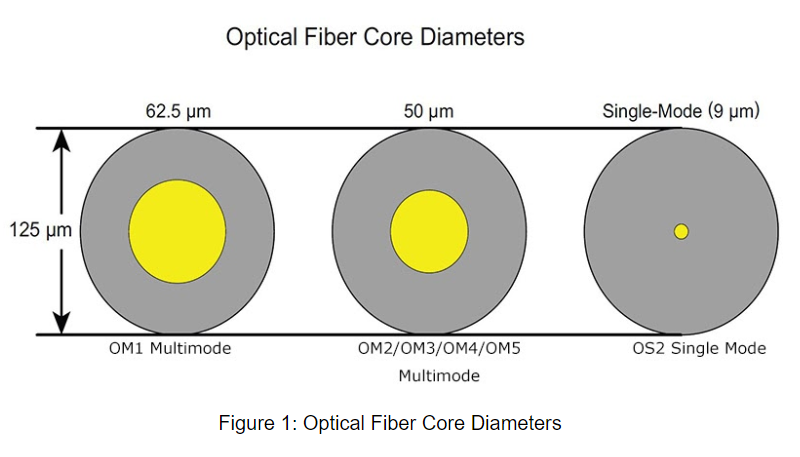
Structural Features: Utilizes tight-buffered cable design, optimized for indoor short-distance installations. Core diameter: 8.3 μm; cladding diameter: 125 μm.
Key Specifications: Maximum attenuation of 1.0 dB/km (at 1310 nm and 1550 nm wavelengths), with a maximum operational distance of 10 km.
OS2 Single-Mode Fiber:
Definition: OS2 is a low-water-peak fiber (LWPF) adhering to ITU-T G.652.C/D and G.657.A1 standards, engineered for extended reach and high-speed networks.
Structural Features: Features loose-tube cable design with enhanced bend resistance (per G.657.A1). Core diameter remains 8.3 μm, but manufacturing processes eliminate water peak absorption at 1383 nm.
Key Specifications: Maximum attenuation of 0.4 dB/km, supporting transmission distances up to 200 km and 40G/100G Ethernet applications.
2. Transmission Performance Analysis
Attenuation and Loss
OS1: Attenuation ranges from 0.3–0.4 dB/km (1310 nm) and 0.18–0.25 dB/km (1550 nm), with a permissible maximum of 1.0 dB/km.
OS2: Achieves lower attenuation (<0.18 dB/km at 1550 nm) and a stricter maximum limit of 0.4 dB/km, reducing total link loss.
Distance and Data Rate
OS1: Supports 1G–10G rates over ≤10 km, ideal for local area networks (LANs) and intra-data-center connectivity.
OS2: Enables 10G–100G transmission over ≤200 km, tailored for metropolitan area networks (MANs), wide area networks (WANs), and submarine cables.
Bandwidth and Wavelength Range
OS1: Limited by water peak absorption at 1383 nm, restricting operation to O-band (1260–1360 nm) and C-band (1530–1565 nm).
OS2: Eliminates water peak, unlocking the E-band (1360–1460 nm) and S-band (1460–1530 nm), enabling coarse wavelength division multiplexing (CWDM) across 1260–1625 nm.
3. Technical Specifications Comparison
| Parameter | OS1 | OS2 |
| Standards | ITU-T G.652.A/B | ITU-T G.652.C/D, G.657.A1 |
| Max Attenuation | 1.0 dB/km | 0.4 dB/km |
| Max Distance | 10 km | 200 km |
| Data Rate Support | 1G–10G | 10G–100G |
| Water Peak | Present at 1383 nm | Eliminated |
| Bend Resistance | Moderate | Excellent (G.657.A1) |
| Cost | Lower | Higher |
4. Applications and Future Outlook
OS1: Cost-effective for short-reach deployments, including enterprise LANs and intra-building cabling.
OS2: Dominates long-haul, high-capacity networks, such as backbone infrastructure, inter-city links, and 100G/400G systems.
Trends: Driven by 5G, cloud computing, and IoT demands, OS2 is becoming the de facto choice for future-proof networks due to its superior loss performance and wavelength flexibility. However, OS1 retains relevance in budget-constrained, low-complexity environments.
5. Conclusion
OS1 and OS2 fibers serve divergent roles in modern optical communication systems. OS2’s advancements in attenuation reduction, water peak suppression, and bend tolerance make it indispensable for high-speed, long-distance applications. Conversely, OS1 remains a pragmatic solution for short-range, cost-sensitive installations. Network planners must prioritize technical requirements, scalability, and total cost of ownership when selecting between these two fiber types.
Author:
HUALUE CO.,Limited









