
English
- English
- Español
- SaudiArabia
News

GPON vs EPON
2025-07-04 18:52:16
Click:
“
Fiber optic networks have revolutionized the way we access high-speed internet,
”
Fiber optic networks have revolutionized the way we access high-speed internet, and among the most common technologies driving this transformation are Passive Optical Networks (PON). Within PON, two prominent standards are GPON (Gigabit Passive Optical Network) and EPON (Ethernet Passive Optical Network). These two technologies provide high-speed broadband solutions but differ in terms of architecture, performance, cost, and other factors.
In this article, we’ll explore the key differences between GPON and EPON, highlight their advantages, and discuss which technology may be more suitable for different use cases.
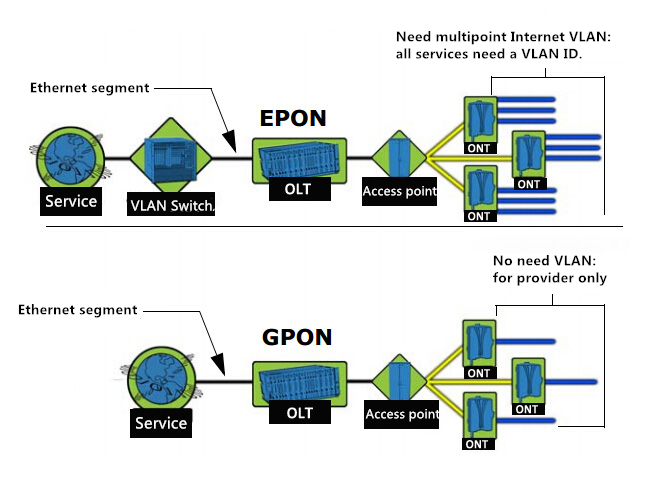
GPON vs EPON — Side-by-Side Comparison
| Feature | GPON (Gigabit PON) | EPON (Ethernet PON) |
|---|---|---|
| Full Name | Gigabit Passive Optical Network | Ethernet Passive Optical Network |
| Standard | ITU-T G.984 | IEEE 802.3ah |
| Protocol | ATM / GEM | Ethernet |
| Downstream Speed | 2.488 Gbps | 1.25 Gbps |
| Upstream Speed | 1.244 Gbps | 1.25 Gbps |
| Bandwidth Symmetry | Asymmetric | Symmetric |
| Efficiency | ~70–90% (due to protocol overhead) | ~90% (native Ethernet) |
| Split Ratio | Up to 1:128 (common 1:64) | Up to 1:64 |
| Max Distance | Up to 20 km | Up to 20 km |
| QoS (Quality of Service) | Stronger, with T-C Layer QoS | Simpler QoS |
| Cost | Slightly higher (more complex) | Generally lower |
| Interoperability | Harder (vendor lock-in more common) | Easier (based on Ethernet standard) |
| Use Cases | Telecom-grade FTTH, IPTV, VoIP | Low-cost FTTH, enterprise, CCTV |
PON, GPON, EPON Overview
Before talking about the specific differences between GPON and EPON, this section provides a brief overview of PON, GPON, and EPON. If you already have knowledge in this area, feel free to skip ahead to the next part.
PON (Passive Optical Network)
A Passive Optical Network (PON) is a telecommunications technology that uses optical fibers to deliver broadband services to users. PON systems are called “passive” because they use passive optical splitters, which do not require electrical power to operate. These networks enable multiple users to share the same optical fiber, significantly reducing the need for additional cabling infrastructure.
GPON (Gigabit Passive Optical Network)
GPON is a widely adopted PON standard defined by the ITU-T (International Telecommunication Union). It supports high-speed internet, voice, and video services through an efficient allocation of bandwidth. GPON is known for its asymmetric data rates, offering higher downstream speeds (2.5 Gbps) compared to upstream speeds (1.25 Gbps). This makes it particularly suitable for residential and business applications that require high download speeds.
EPON (Ethernet Passive Optical Network)
EPON, developed by IEEE, is another PON technology that supports Ethernet-based data transport over fiber-optic networks. Unlike GPON, EPON uses Ethernet framing for data transmission, which simplifies the protocol stack and can offer better integration with existing Ethernet networks. EPON typically has symmetrical data rates, meaning the upstream and downstream speeds are equal (1.25 Gbps).

Differences Between GPON and EPON
There are specific differences between GPON and EPON, comparing various aspects such as performance, scalability, and cost.
1. Data Rate: GPON vs EPON Performance
GPON supports a variety of data rate levels, with downstream speeds of 2.5 Gbps and upstream speeds of 1.25 Gbps. This flexibility allows for custom configurations to optimize cost and performance based on user needs. GPON’s 2.5 Gbps downstream speed is a key feature, offering enhanced performance for demanding applications, and it aligns well with modern 2.5GbE technology.
EPON, on the other hand, has a fixed data rate of 1.25 Gbps for both uplink and downlink, resulting in an actual rate of 1 Gbps due to 8b/10b line coding.
Verdict: GPON provides more flexibility and higher performance, making it better suited for high-demand environments.
2. Splitter Ratio: Scalability and Distance
GPON can support splitter ratios of up to 1:128, with the most common configurations being 1:32. The maximum reach for a 1:16 splitter is 20 km, while a 1:32 splitter can reach up to 10 km.
EPON typically supports splitter ratios from 1:16 to 1:128. So EPON OLTs can support more EPON ONUs. However, as the splitter ratio increases, the transmission distance decreases due to higher insertion losses, making EPON less suitable for long-distance deployments.
Verdict: GPON offers more predictable performance over longer distances, making it ideal for large-scale deployments.
3. Quality of Service (QoS)
GPON provides integrated QoS features, including support for Ethernet, TDM, and ATM, ensuring high service reliability and efficient bandwidth allocation. This makes GPON well-suited for complex, multi-service environments that require high QoS levels.
EPON does not have built-in QoS capabilities. However, many EPON vendors use VLAN tagging as a workaround to implement QoS, though this approach can be costly and less efficient.
Verdict: GPON is superior in terms of built-in QoS, offering more reliable service quality.
4. Operations, Administration, and Maintenance (OAM): Ease of Management
GPON has robust OAM capabilities, including PLOAM (Physical Layer OAM) and OMCI (ONT Management and Control Interface), which facilitate fault detection, network monitoring, and overall management. These features make GPON networks easier to maintain and manage at scale.
EPON, in contrast, offers limited OAM support, relying mostly on basic monitoring features. This can make network maintenance more challenging, particularly in larger, more complex deployments.
Verdict: GPON’s OAM capabilities provide better control and easier network management.
5. Costs: Which is More Cost-Effective?
While both GPON and EPON networks have similar costs for passive optical components and fiber infrastructure, EPON is generally less expensive in terms of the optical modules and chipsets it uses. EPON typically employs lower-cost ASICs (Application-Specific Integrated Circuits) and optical modules, which makes it more budget-friendly upfront.
However, GPON’s higher cost may be justified by its superior performance, scalability, and advanced features.
Verdict: EPON is more cost-effective in terms of initial deployment costs, while GPON may offer a better long-term investment due to its higher performance.
In addition to comparing GPON and EPON, it’s also important to consider how xPON technology fits into the picture. This hybrid solution combines features of both GPON and EPON, offering flexibility and scalability. For a detailed comparison of xPON vs. EPON vs. GPON, check out our article on how xPON differs from EPON/GPON.
Choice Between GPON and EPON for Different Scenarios
Both GPON and EPON ensure seamless connectivity, you may choose between them based on different use cases and scenarios. Whether you’re looking for high performance, cost-effectiveness, or simplicity, you can select the best option to meet your needs.
- GPON is the ideal choice for customers who require high bandwidth, efficient multi-service support, and reliable QoS. It’s well-suited for large-scale deployments, high-demand residential areas, and enterprise networks that require advanced features and high performance.
- EPON is better suited for cost-sensitive deployments where performance demands are moderate. It’s a good choice for smaller networks or areas where budget constraints are a priority, and where advanced features like QoS and extensive management capabilities are not critical.
HUALUE has developed a comprehensive range of GPON and EPON products to meet diverse network demands. This includes not only EPON and GPON ONUs and OLTs but also advanced xPON ONU routers that are backward compatible with both EPON and GPON. This compatibility allows seamless integration with existing network infrastructures, offering greater flexibility for service providers to deploy or upgrade their networks without compatibility concerns.
By delivering high-performance, scalable, and cost-effective solutions, HUALUE ensures reliable connectivity for residential, commercial, and enterprise applications.
Conclusion
In summary, GPON and EPON each have their strengths, and the choice between the two depends on your specific needs. GPON is the superior option in terms of performance, service quality, and network management, making it suitable for high-demand, large-scale networks. On the other hand, EPON offers a more cost-effective solution, ideal for smaller deployments with lower service requirements.
Both technologies are widely used in FTTH deployments, and the right choice will depend on factors like network size, budget, and the need for advanced features.









