English
- English
- Español
- SaudiArabia
News

Why Fiber Optic Cable Is the Optimal Choice for Data Centers and How to Deploy It Effectively?
2026-02-07 17:29:41
Click:
“
As AI, cloud computing, and big data reshape the digital landscape, data centers
”
As AI, cloud computing, and big data reshape the digital landscape, data centers face growing demands for faster, more reliable, and scalable connectivity. Traditional copper cabling is no longer sufficient to meet these evolving requirements. Fiber optic cable, enabling high-speed, high-capacity data transmission with exceptional interference immunity, is rapidly becoming the foundation of next-generation data center infrastructure. This article explores the key advantages of fiber optic connectivity and provides five actionable steps for deploying it effectively.
Why Fiber Optic Cable is the Optimal Choice for Data Centers
High Bandwidth and Data Transmission
Fiber optic cable transmits data through light pulses, enabling ultra-high-speed data transfer with rates ranging from 100G to 800G, far surpassing traditional copper cables. This makes it ideal for compute-intensive applications such as AI and big data. Single-mode fiber, with its smaller core diameter and support for long-distance transmission (e.g., up to 10 km or more for campus-wide or metropolitan links), ensures seamless synchronization of distributed AI training tasks. Multimode fiber, renowned for its cost efficiency and high throughput, is widely utilized for short-range interconnects, including intra-rack or adjacent-rack connections. It is particularly well-suited for GPU server clusters exchanging terabytes of gradient parameters during model training.
Higher Space Utilization
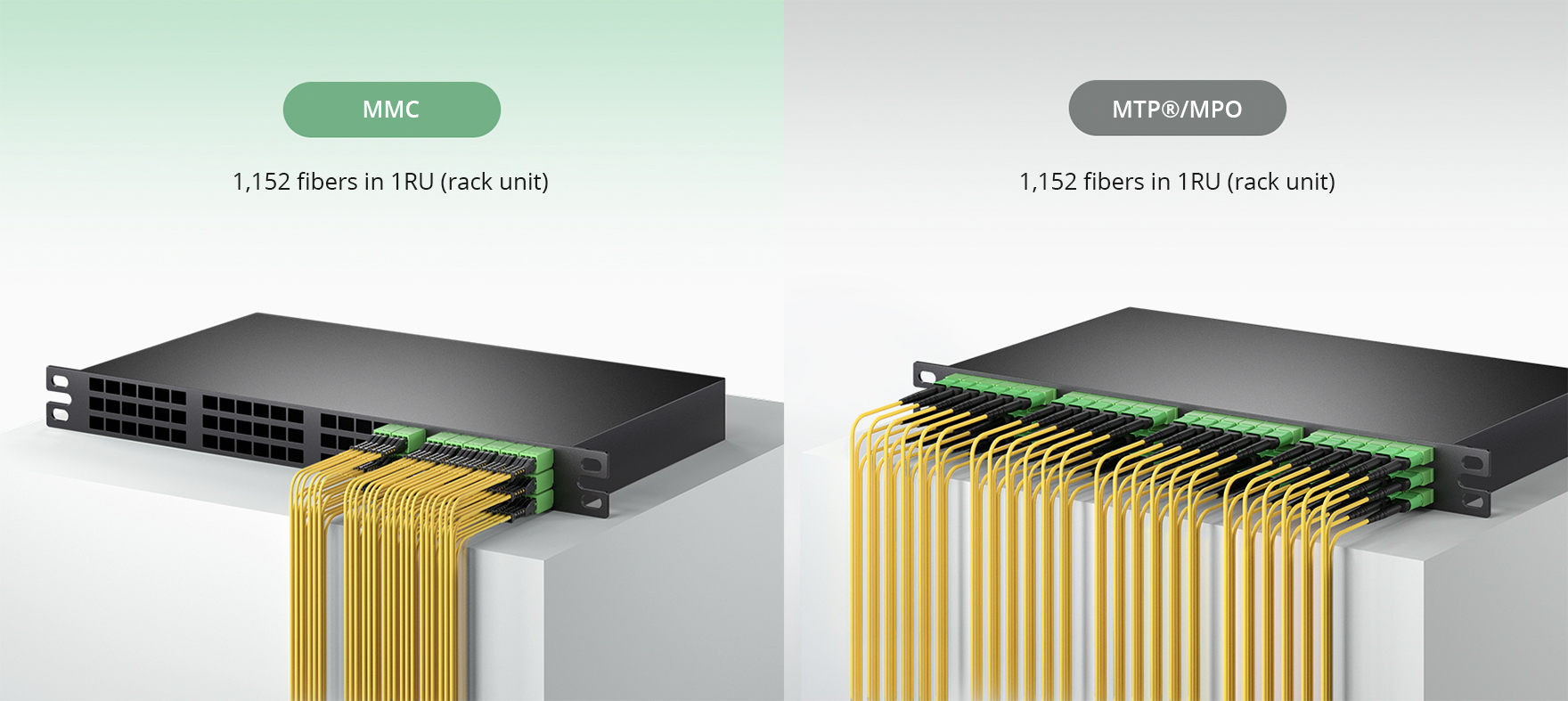
Fiber optic cables are thinner than copper cables, offering more space-efficient connections. This increased density allows greater rack utilization within data centers, optimizing Power Usage Effectiveness (PUE). As AI computing continues to grow, data centers require flexible infrastructures to handle the expanding data and computational demands. Fiber-dense networks offer seamless scalability, minimizing operational disruptions caused by cabling changes. By utilizing compact VSFF connectors like MMC, fiber connectivity can achieve significantly higher connection density. For instance, an MMC fiber jumper can triple cabling port density compared to MPO fiber patch cords, allowing for the seamless integration of additional servers and storage without requiring major infrastructure modifications.
Reduced Power Consumption and Cooling Costs
Fiber optic cables consume less power than copper cables, which is crucial for AI data centers. High-power GPU server clusters are already the primary energy consumers in data centers. Fiber's low-loss transmission characteristics can effectively reduce the power consumption of network equipment and lower operational costs. Additionally, proper cable management optimizes airflow distribution, improving HVAC (Heating, Ventilation, and Air Conditioning) efficiency and further reducing cooling costs.
Superior Signal Integrity and Security
AI computing involves massive data processing, making data accuracy and transmission stability critical. Optic fiber is resistant to electromagnetic interference (EMI), ensuring stable data transmission even in high-density server environments and preventing signal degradation or increased error rates.
From a security perspective, fiber optic cable does not emit electromagnetic signals and is nearly impossible to tap, making it more secure than copper cables. This is particularly important for transmitting high-value data, such as AI training datasets and financial transactions. For enterprises, adopting fiber connectivity can reduce data breach risks and ensure the confidentiality of core business operations.
How to Effectively Deploy Fiber Optic Cables in Data Centers?
As AI workloads continue to grow, deploying a reliable and scalable fiber optic cable infrastructure is essential. The following five steps outline how to implement fiber connectivity for maximum performance and future readiness.
Step 1: Plan Scalable Fiber Routing
A well-thought-out routing plan helps minimize rework, improve deployment efficiency, and ensure long-term scalability. This planning stage involves two key aspects:
Start by evaluating both current and future network needs, including required transmission speeds, anticipated bandwidth growth, and equipment density.
Design logical fiber paths that avoid physical obstructions (such as conduits, ducts, and structural components) and sources of electromagnetic interference (EMI), while calculating precise cable lengths to prevent slack and congestion. Also, reserve sufficient rack space and patch panel ports for future expansion and speed upgrades.
Step 2: Select the Right Fiber Optic Cable Type
Building on the specific needs identified in Step 1, selecting the right type of fiber optic cable is critical to ensuring optimal performance, scalability, and return on investment (ROI). Key considerations include transmission distance, space constraints, and installation environment. The main cable types and their typical applications include:
Single-mode vs. Multimode Fiber Cables: Single-mode fiber is ideal for long-distance, high-bandwidth transmission, commonly used for backbone links or inter-building connections with distances typically over 10 km. Multimode fiber suits short-range high-speed interconnections inside data centers, with max distances between 300–550 meters.
MTP®/MPO Fiber Cables: Ideal for large-scale data centers or cloud environments, these solutions save rack space and improve installation efficiency.
Armored and Industrial Armored Cables: Armored cables offer superior mechanical protection and can be directly laid in harsh indoor conditions without additional conduit, reducing complexity and cost. Industrial armored cables with rugged TPU jackets provide excellent tensile, compression, and bending resistance, making them suitable for outdoor conduits or direct-burial installations between buildings.
Fiber Pigtails: High-performance fiber pigtails help reduce insertion loss and enhance termination quality, commonly used in distribution frames and terminal boxes.
Step 3: Ensure Proper Installation Practices
Improper handling of fiber optic cables can degrade signal performance. Following best practices ensures long-term network stability.
Use protective tubing and proper pulling tools. Never exceed the minimum bend radius or tensile load.
Clean all connectors using fiber optic cleaners, such as one-push pen cleaners, before installation to avoid signal contamination. For detailed cleaning procedures, please refer to our Fiber Optic Cleaning Guide.
Apply structured cable management solutions such as vertical/horizontal managers and cable ties to maintain clear routing and airflow.
Label both ends of each fiber cable and maintain documentation to support future maintenance and troubleshooting.
Step 4: Perform Routine Maintenance
Regular inspection and cleaning of fiber optic cables are critical to maintaining network performance.
Inspect fiber cables for damage, tight bends, dust, or loose connectors.
Use tools such as OTDRs to test insertion loss and return loss regularly, ensuring compliance with TIA/EIA and IEEE standards.
Replace aged or damaged fiber optic cables in time to prevent signal degradation.
By following the above steps—from careful planning and cable selection to proper installation—network teams can build a scalable, modular fiber optic infrastructure. Modular, pre-terminated fiber cable systems enable faster deployment, simplified maintenance, and easier future upgrades, helping organizations meet the growing demands of high-density data environments, AI workloads, and cloud platforms.
Conclusion
Fiber optic cable delivers the performance, efficiency, and future readiness that modern data centers demand. By selecting suitable cable types, ensuring proper installation, and planning for scalability, enterprises can build a robust and high-performing fiber infrastructure to support AI and data-intensive workloads. Ready to upgrade your network? Explore HUALUE's comprehensive fiber optic solutions to accelerate your digital transformation.