
English
- English
- Español
- SaudiArabia
News

What is HCF (hollow core fiber)
2026-07-01 11:04:25
Click:
“
What is HCF (hollow core fiber)Hollow core fiber is an optical fiber that uses a
”
What is HCF (hollow core fiber)
Hollow core fiber is an optical fiber that uses air as the transmission medium. Its hollow structure reduces signal attenuation, and it is primarily used for energy transmission. Its structure is divided into air-glass interface total internal reflection type and photonic bandgap type. Hollow core photonic crystal fiber (HC-PCF) is manufactured using standard drawing processes, achieving a minimum loss of 1.7 dB/km in the 1550 nm communication band. This technology can transmit X-rays, ultraviolet light, and far-infrared light energy, and possesses low latency and low nonlinear effects.

In 2025, a Microsoft team developed double-layer nested antiresonant nodeless fiber (DNANF), achieving an attenuation level of 0.091 dB/km in the 1550 nm band. China Mobile's commercially deployed antiresonant hollow fiber lines have an average loss of 0.085 dB/km and a transmission speed approaching 300,000 km/s. China Telecom has built the world's longest 100-kilometer commercial hollow fiber cable, achieving a bidirectional latency of 0.93 milliseconds based on the OSU transmission system. YOFC's hollow structure products are used in financial data center interconnects, achieving transmission speeds close to the speed of light in a vacuum. Current research focuses on optimizing loss spectrum flatness, expanding material applications, and improving manufacturing processes.
Applications:
Among the applications of photonic crystal materials explored by optical physicists, optical fiber is undoubtedly one of the most promising. Photonic crystal fiber (PCF) is a novel type of optical waveguide with properties drastically different from ordinary optical fibers. This new type of fiber can be divided into two basic types—refractive index waveguides and bandgap waveguides. Due to the large degree of freedom in the transverse refractive index distribution, refractive index waveguide PCF can be designed to possess properties such as high anomalous dispersion, nonlinearity, and birefringence. However, in these types of fibers, most light still propagates within the glass. Bandgap waveguides and hollow fibers are recognized as the most revolutionary innovations in photonic crystal fiber technology. In these types of fibers, light is confined to a central hollow core by creating a photonic bandgap in the fiber cladding.
Using a hollow core, instead of the traditional high-purity doped silicon core, has the advantage that the fiber performance is not limited by the material properties of the core. Parameters of traditional optical fibers, such as damage threshold, attenuation, nonlinear effects, and group velocity dispersion, are all affected by the corresponding parameters of the silicon material. Through proper design, hollow optical fibers can allow over 99% of light to propagate through air rather than glass, significantly reducing the impact of fiber material properties on optical properties and fiber performance. Therefore, in many important fields, hollow photonic crystal fiber (HC-PCF) offers advantages over traditional optical fibers.
China Telecom plans to build the world's longest commercial 100-kilometer hollow optical cable by 2025, achieving a bidirectional latency of 0.93 milliseconds based on an OSU transmission system, validating the commercial value of this technology in latency-sensitive services.
Hollow-core fiber is primarily used for energy transmission, enabling the transmission of X-rays, ultraviolet light, and far-infrared light. There are two main structural types of hollow-core fibers: One type uses a cylindrical glass core, with the core and cladding structure similar to a step-index fiber. It utilizes total internal reflection between the air and the glass for propagation. Since most of the light can propagate through lossless air, it has a certain distance propagation capability. The second type has a reflectivity close to 1 on the inner surface of the cylinder to reduce reflection loss. To further improve reflectivity, a dielectric material is placed inside the cylinder, reducing loss at the operating wavelength. For example, losses of several dB/m can be achieved at a wavelength of 10.6 pm.
Hollow-core photonic crystal fiber can guide light through air instead of glass, giving it advantages over traditional optical fibers in many applications and ultimately leading to its replacement.
Future Outlook
Future research will primarily focus on further expanding and optimizing fiber optic design, material properties, and manufacturing processes. Reducing loss is undoubtedly a major goal. Meanwhile, China Telecom's hollow-core fiber quantum-classical co-fiber transmission technology provides an innovative solution to the signal interference problem in traditional optical fibers. While 1.7 dB/km is a significant milestone, in applications where loss must be considered, replacing even the best traditional optical fibers with hollow-core photonic crystal fibers made of silicon is entirely possible.
Another exciting possibility is that low-loss optical fibers can be made from relatively high-loss materials, provided that only a small amount of light can actually 'see' the glass. This characteristic is particularly significant in the far-infrared band (where glass manufacturing technology is highly advanced), potentially leading to the development of high-power optical fibers with wavelengths as low as 10.6 μm. Furthermore, significant progress has been made at the other end of the spectrum in hollow photonic crystal fibers, with the first hollow photonic crystal fiber located in the visible and ultraviolet bands already commercialized. China Telecom's achievements are expected to propel hollow fiber from the laboratory to large-scale commercial application, driving upgrades in optical fiber manufacturing, quantum devices, and the entire ICT industry chain. For example, the deployment of cross-border long-distance hollow fiber networks has significantly improved transmission efficiency and reduced response times for latency-sensitive services such as financial transactions and intelligent computing collaboration, validating the technology's potential for transitioning from experimental to commercial applications. Such commercial advancements mark the formal entry of hollow fiber technology into the practical application stage, providing an all-optical intelligent interconnection foundation for computing networks and highlighting its core value in reducing latency and enhancing collaborative capabilities. Although hollow photonic crystal fiber technology has made great progress since its initial report, it is still in the early stages of development. Therefore, hollow photonic crystal fiber will continue to move forward.
Main differences
Unlike traditional optical fibers, photonic crystal fibers do not guide light through total internal reflection. Instead, the principle of light guidance in photonic crystal fibers is very similar to the reflection principle of multilayer mirrors. Multilayer mirrors achieve total internal reflection through in-phase reflection from numerous dielectric surfaces. In hollow photonic crystal fibers, a two-dimensional array of tiny air holes runs through the entire fiber, acting as the dielectric layers of a multilayer mirror. To confine light within the core, the small holes around the core must be arranged in a very uniform and regular grid, and they must be close to, if not touching, each other. Thus, the cross-section of the cladding resembles a honeycomb composed of fine silicon filaments, sometimes as small as 100 nm. This grid acts as an ideal reflector, confining light within the core, but the reflectivity of the grid is limited by the propagation constant. Therefore, the spectral response range of hollow photonic crystal fibers differs significantly from that of traditional optical fibers; it can only guide light within a certain frequency range, typically around 20% of the center frequency. Despite this, the mode distribution in hollow photonic crystal fibers is still very similar to that of traditional single-mode fibers.
Manufacturing
Hollow photonic crystal fibers (HCFs) can be produced using standard fiber drawing equipment. First, hundreds of thin-walled capillaries are stacked together to create a semi-finished product. Then, through cladding, drawing, and polymer coating, an fiber with dimensions and mechanical properties very similar to standard single-mode fiber is obtained. The manufacturing process for HCFs has advanced very rapidly, even enabling the production of fibers of unlimited length with consistent optical properties—at least, this is achievable with HCFs made from fused silica glass.
Because only a very small amount of light actually propagates within the glass, the energy transmission capacity of HCFs is far superior to that of traditional fibers.
Although the transmission bandwidth of HCFs is largely determined by the photonic bandgap of the cladding, even small variations in the core size and shape, as well as the distribution of solid material around the hollow core, can significantly alter the fiber's optical properties. Therefore, it is not surprising that much current research focuses on improving fiber design and related manufacturing processes.
Loss
Taking hollow photonic crystal fiber in the communication band as an example, its low-loss range is approximately 150 nm, with a center wavelength of 1570 nm (Figure 1). Outside this range, the loss increases rapidly. The minimum loss is 1.7 dB/km, which has been proven to be the minimum achievable by hollow waveguides (Figure 2). Within this low-loss window of the fiber, there are some high-loss regions. This is a result of surface films (so-called surface films refer to resonances at or near the glass-air interface in the core), which gradually degrade at certain wavelengths. At the wavelengths where degradation occurs, the light interacting with the surface increases dramatically, leading not only to increased fiber loss but also altering the waveguide's dispersion characteristics. These characteristics are detrimental in practical applications. However, with careful design of the core and cladding, it is possible to eliminate these adverse factors.
Transmission
While hollow photonic crystal fibers (HPVs) cannot yet challenge traditional optical fibers in long-distance communication, they outperform them in several other important applications, most notably laser beam transmission. A key advantage of HPVs over traditional optical fibers is their higher damage threshold. Because only a very small amount of light actually travels within the glass, the energy transmission capacity of HPVs is far superior to that of traditional optical fibers.
Figure 1 shows an electron micrograph of the cross-section of a low-loss hollow photonic crystal fiber used in the communication band. This fiber exhibits a minimum loss of 1.7 dB/km at a wavelength of 1550 nm.
Another difference is the lower optical nonlinearity of hollow photonic crystal fibers, resulting from minimal overlap between light and glass. Crucially, the nonlinear refractive index of the gas in the core is approximately 1000 times smaller than that of solid silicon, resulting in nonlinear characteristics in hollow photonic crystal fibers that are three orders of magnitude smaller than those in conventional fibers. Therefore, both continuous waves and short pulse sequences can be transmitted in hollow photonic crystal fibers at very high power without spectral distortion. In fact, hollow photonic crystal fibers can be designed so that the nonlinearity of the core gas or glass determines the overall nonlinearity of the fiber. Furthermore, in addition to air, other gases can be introduced, allowing for complete control over the fiber's nonlinear characteristics.
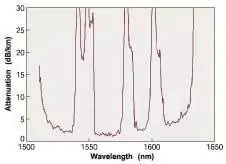

Figure 1 Figure 2
Figure 2 shows an increase in the core size of the hollow photonic crystal fiber (as shown in Figure 1). While this reduces loss, it also introduces more surface film cross-links, resulting in numerous spikes in the loss spectrum. Smaller cores offer wider bandwidth and smoother spectra, but at the cost of increased loss.
It is noteworthy that new limiting factors begin to emerge when the pulse width is less than 1 ps. The intrinsic bandwidth of the pulse begins to rival the width of the low-loss window in the hollow photonic crystal fiber. Furthermore, group velocity dispersion in the hollow photonic crystal fiber means that pulses shorter than 1 ps will exhibit significant dispersion after only a few meters of propagation. However, importantly, the low nonlinearity of the hollow photonic crystal fiber ensures that such dispersion does not result in significant spectral distortion, even for pulses with a pulse width of 100 fs and peak power reaching the level of a typical mode-locked laser oscillator.
In traditional optical fibers, due to the combined effects of nonlinearity and dispersion, even short pulses can only propagate for a few millimeters before being quickly split. The low nonlinearity of hollow photonic crystal fibers (HCFs) means that, with proper compensation for linear dispersion—for example, by pre-chirping the pulse with a piece of glass before coupling into the fiber—pulses can propagate several meters in HCFs. Another possibility is to utilize the low nonlinearity of HCFs to balance linear dispersion, allowing pulses to propagate as solitons within the HCF. Previously, fiber solitons were observed using traditional fibers at relatively low power levels, in the 1500nm band. However, HCFs can propagate high-intensity pulses with peak powers of several megawatts over a wide wavelength range.
Author:
HUALUE CO.,Limited









