
English
- English
- Español
- SaudiArabia
News

What is ONU: Concept, Features and Types
2025-07-02 15:01:56
Click:
“
What is ONU: Concept, Features and TypesDo you know the GPON? If you have known,
”
What is ONU: Concept, Features and Types
Do you know the GPON? If you have known, you should know what is an optical network unit (ONU). Here is an overview of the optical network unit. By the way, GPON means Gigabit Passive Optical Network. You can learn more from this article: .
Concept of ONU
Optical Network Unit, the IEEE term for what is called an Optical Network Terminal in ITU-T terminology.
The ONU is divided into an active optical network unit and a passive optical network unit. Generally, the devices equipped with optical receivers, uplink optical transmitters, and multiple bridge amplifier network monitoring equipment, are called optical nodes.
The PON connects to the OLT, using a single optical fiber and the OLT connects to the ONU. ONU realizes 'triple-play' applications by providing services such as data, IPTV (interactive network television) and voice (using IAD and Integrated Access Device).
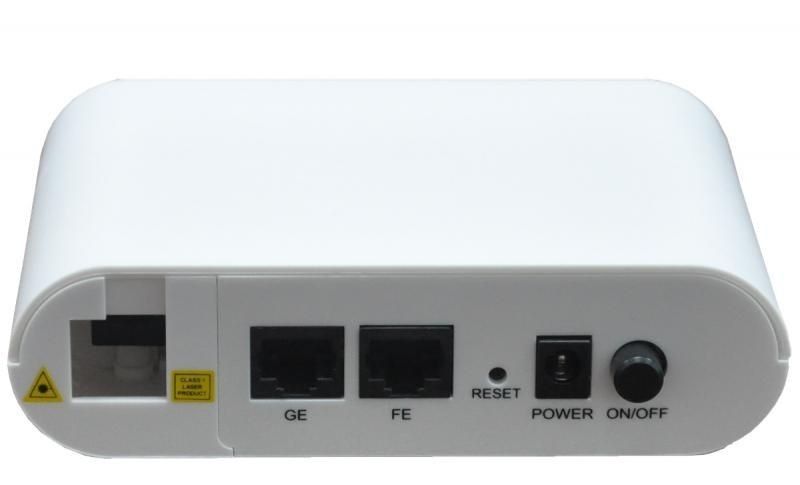
Features of ONU
The Optical Network Unit can:
- Choose to receive broadcast data sent by the OLT;
- Respond to the ranging and power control commands sent by the OLT; and make corresponding adjustments;
- Cache the user's Ethernet data, send it in the uplink direction through the transmission window allocated by the OLT;
- Fully compliant with IEEE 802.3 / 802.3ah;
- Deliver up to -25.5dBm Receive sensitivity;
- Provide up to -1 to + 4dBm Transmit power;
- Realize 'triple-play' applications by providing services such as data, IPTV (that is, interactive network television), voice (using IAD, Integrated Access Device Integrated Access Device);
- Deliver the highest rate PON: symmetrical 10Gb / s data uplink and downlink, VoIP voice and IP video services;
- Provide Plug and Play' based on auto discovery and configuration;
- Offer the Advanced Quality of Service (QoS) functions based on service level agreement (SLA) billing;
- Deliver the Rich remote management capabilities supported by OAM functions;
- Provide High sensitivity light reception and low input optical power consumption;
- Support Dying Gasp function.
Types of ONU
The ONU is divided into an active optical network unit and a passive optical network unit.
Active ONU
The Active optical network unit is mainly used in triple play, which integrates the full range of CATV RF output. It provides high-quality VOIP audio, three routing mode, wireless access and other functions. It’s easy to access to triple play terminal equipment.
Passive ONU
The Passive Optical Network Unit is a user-side device of the GEPON (Gigabit Passive Optical Network) system and is used to terminate the traffic transmitted from the OLT (Optical Line Terminal) through EPON (Passive Optical Network).
In conjunction with the OLT, ONUs provide various broadband services for the connected users, such as Internet surfing, VoIP, HDTV, Video Conference and other business.
The ONU, as a user-side device for FTTx applications, is a high-bandwidth, cost-effective terminal device necessary for the transition from 'Copper Age' to 'Fiber Age.' As the ultimate solution for wired access to users, GEPON ONU plays an important role in the overall network construction of NGN (Next Generation Network) in the future.









