
English
- English
- Español
- SaudiArabia
News

Why Multimode MTP®/MPO APC Connectors Are Critical for AI Data Centers
2025-06-05 10:04:46
Click:
“
The exponential growth of AI workloads has pushed data centers to adopt 100G/400
”
The exponential growth of AI workloads has pushed data centers to adopt 100G/400G+ transmission speeds using PAM4 signaling. Traditional multimode MTP®/MPO connectors with UPC (Ultra Physical Contact) interfaces offer space-efficient design but struggle with return loss, which may distort PAM4’s precision. Here, we recommend MTP®/MPO connectors with an APC (Angled Physical Connect) design, engineered to tame reflections and safeguard AI’s high-stakes data pipelines.
AI Data Center Cabling Challenge: Speed vs. Signal Integrity
PAM4 in AI’s 100-800G Result in Signal Loss
AI training, particularly for large language models (LLMs), relies on massive parallel data transfers between GPUs/TPUs at 100G/400G/800G speeds. PAM4 modulation, with its four signal levels (00, 01, 10, 11), doubles the efficiency of traditional NRZ encoding. Therefore, PAM4 can achieve higher spectral efficiency in the current high-speed AI fiber networks, reducing hardware complexity and cost. However, its 'narrower eye diagram' (see eye pattern in Figure 1) makes it highly susceptible to interference. Even minor reflections caused by dust, scratches, or connector imperfections can scatter light back to the transmitter, introducing noise that corrupts PAM4’s multilevel pulses. These errors trigger retransmissions, increasing latency and prolonging AI training cycles. This is a costly bottleneck for time-sensitive AI deployments.
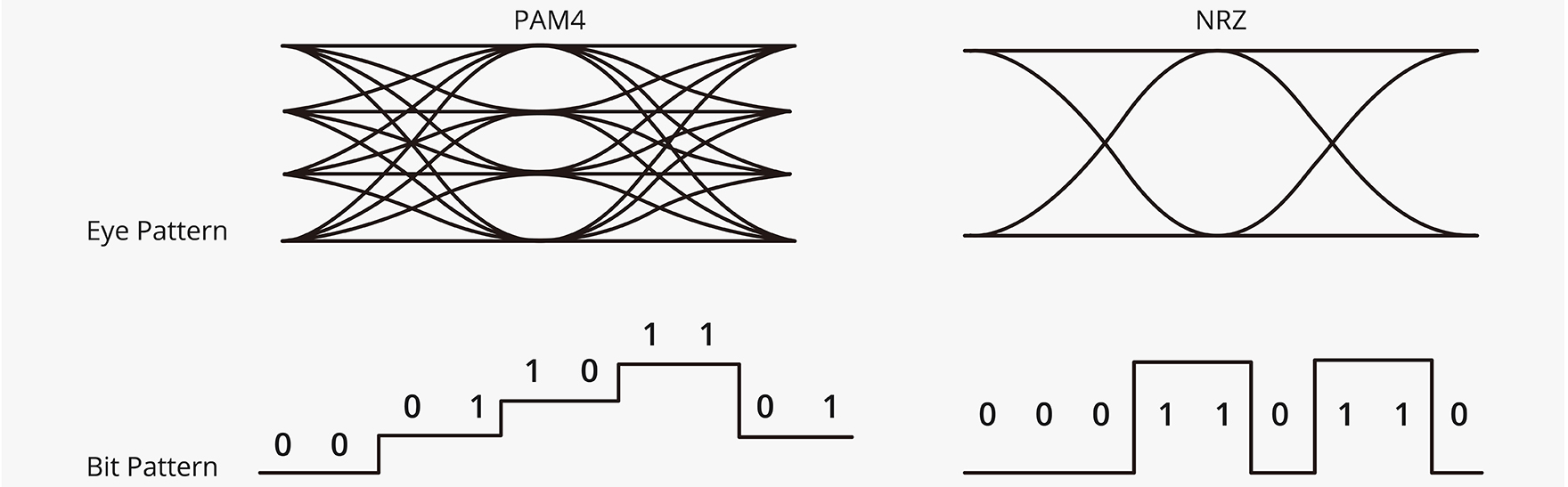
Figure 1: PAM4 vs NRZ
Multimode MTP®/MPO’s UPC Lead to Reflection Challenges in Short-reach AI Networks
As Table 1 shows (source: Commscope), multimode MTP®/MPO-8/16 solutions support 100G–800G transmission up to 100 meters. This indicates that in most cases, multimode MTP®/MPO fibers can satisfy AI-driven data centers' requirements for speed and distance, especially where GPUs/TPUs are confined within racks or adjacent aisles. However, the larger core of multimode fibers allows multiple light modes to propagate, creating complex reflections at interfaces. Plus, most common multimode MTP®/MPO cables like MTP®/MPO 12- and 24-fiber cables, as well as some MTP®/MPO 8-fiber cables in recent years, mainly use UPC end-face. Its slight curvature design can not effectively reduce the reflected lights. These reflections exacerbate return loss, especially at 100/400/800G high-speeds with PAM4 encoding, resulting in increased bit error rates.
Data rate | PMD (Physical Medium Dependent) | Fiber media | Reach | Fiber counts | Lane rate | Wavelength numbers |
100G | SR4 | 4-pair MM | 100m | 8 | 25G | 1 |
SR2 | 2-pair MM | 100m | 4 | 50G | 1 | |
PSM4 | 4-pair SM | 500m | 8 | 25G | 1 | |
400G | SR8 | 8-pair MM | 100m | 16 | 50G | 1 |
SR4.2 | 4-pair MM | 100m | 8 | 50G | 2 | |
SR4 | 4-pair MM | 100m | 8 | 100G | 1 | |
VR4 | 4-pair MM | 50m | 8 | 100G | 1 | |
DR4 | 4-pair SM | 500m | 8 | 100G | 1 | |
DR2 | 2-pair SM | 500m | 4 | 200G | 1 | |
800G | SR8 | 8-pair MM | 100m | 16 | 100G | 1 |
VR8 | 8-pair MM | 50m | 16 | 100G | 1 | |
SR4.2 | 4-pair MM | 100m | 8 | 100G | 2 | |
VR4.2 | 4-pair MM | 50m | 8 | 100G | 2 | |
DR8 | 8-pair SM | 500m | 16 | 100G | 1 | |
DR8-2 | 8-pair SM | 2000m | 16 | 100G | 1 | |
DR4 | 4-pair SM | 500m | 8 | 200G | 1 | |
DR4-2 | 4-pair SM | 2000m | 8 | 200G | 1 |
Table 1: Distance of multimode fibers in high-speed AI networks.
How Multimode MTP®/MPO with APC Solves PAM4’s Reflection Problem
APC’s 8° Angle Redirects Reflections to Save Signals
Unlike UPC’s subtle dome-shaped polish, APC connectors feature an 8° angled endface (see Figure 2). This design redirects reflected light into the fiber cladding, where it’s absorbed or scattered—not bounced back to the source. As a result, APC connectors reduce the impact of return loss in fiber channels, providing a higher level of assurance compared to traditional structured cabling.
In high-speed AI networks utilizing PAM4 modulation, APC’s low-reflection properties reduce noise sensitivity, ensuring signal integrity. Check out the article APC vs. UPC connector for more details about the two fiber connector types.
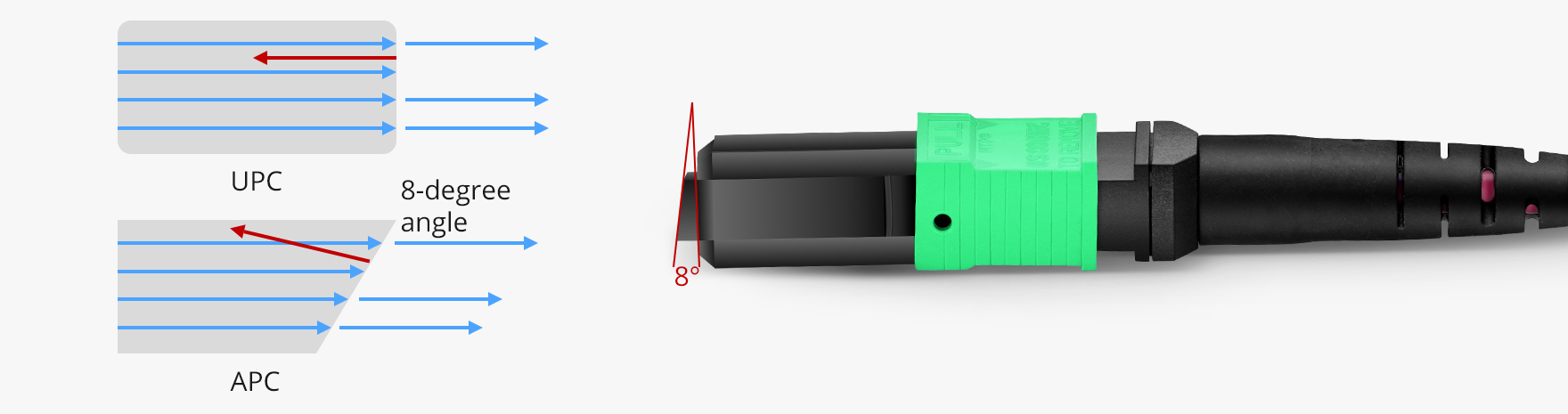
Figure 2: APC’s 8° angle design redirects light to the cladding.
Multimode MTP®/MPO APC vs. UPC
As mentioned above, as data rates increase to 50G–100G per channel and beyond, multimode transmission has shifted toward PAM4 modulation. However, traditional multimode MTP®/MPO UPC struggles to overcome data failures caused by external environmental interference. Consequently, multimode MTP®/MPO APC products have gradually emerged in the market.
These MTP®/MPO APC fiber cable products simplify cabling while enabling multi-fiber transmission and reducing the impact of return loss in fiber channels. This directly addresses the sensitivity requirements of higher data rates that rely on multi-level modulation. The table below summarizes the comparison between multimode MTP®/MPO APC and MTP®/MPO UPC.
Attribute | Multimode MTP®/MPO APC | Multimode MTP®/MPO UPC |
Reflection path | Multi-mode reflection, the light is scattered and absorbed by the inclined surface | Multi-mode reflection, complex path |
High speed adaptability | Excellent (Support 400/800G PAM4 transmission) | Poor (high risk of PAM4 eye closure) |
Cost | 8° angle polishing, slightly more expensive but necessary | Slight curvature, low cost |
Table 2: Comparison of multimode MTP®/MPO APC vs UPC
HUALUE MTP®/MPO Multimode APC Products: Empowering AI Data Centers
Recognizing these industry challenges, HUALUE has been at the forefront of deploying advanced optical connectivity solutions. With the advent of standardized 400GBASE-SR4/SR8 optical devices, HUALUE has introduced a range of multi-mode MTP®/MPO APC products engineered to meet the rigorous demands of modern AI data centers. These products not only support the high-speed, high-density interconnects required for AI workloads but also offer custom options tailored to specific operational environments.
MTP®/MPO Type | Recommend MTP®/MPO Cable | Recommend modules | |
400G | 800G | ||
MTP®/MPO Jumper | MTP®/MPO-12 APC (Female) to MTP®/MPO-12 APC (Female), OM4, NVIDIA/Mellanox Compatible | NVIDIA/Mellanox Compatible 400GBASE-SR4 Generic Compatible 400GBASE-SR4 QSFP112 NVIDIA/Mellanox Compatible 400GBASE-SR4 OSFP NVIDIA InfiniBand 400GBASE-SR4 QSFP112 NVIDIA InfiniBand 400GBASE-SR4 OSFP | Arista Compatible 800GBASE 2 x SR4/SR8 NVIDIA InfiniBand 800GBASE 2 x SR4/SR8 OSFP |
MTP®/MPO-16 APC (Female) to MTP®/MPO-16 APC (Female), OM4 | Cisco Compatible 400GBASE-SR8 QSFP-DD Generic Compatible 400GBASE-SR8 OSFP | Cisco Compatible 800GBASE-SR8 QSFP-DD | |
MTP®/MPO Harness | MTP®-16 APC (Female) to 8 LC UPC Duplex, OM4 | Generic Compatible 400GBASE-SR8 QSFP-DD | —— |
MTP®/MPO Breakout | MTP®/MPO-12 APC (Female) to 2 x MTP®/MPO-4 APC (Female), OM4, NVIDIA/Mellanox Compatible | NVIDIA InfiniBand 400GBASE-SR4 OSFP NVIDIA InfiniBand 400GBASE-SR4 QSFP112 | NVIDIA/Mellanox Compatible 800GBASE 2 x SR4/SR8 OSFP |
MTP®/MPO-16 APC (Female) to 2 x MTP®/MPO-8 UPC (Female), OM4 | NVIDIA/Mellanox Compatible 400GBASE-SR8 QSFP-DD | —— | |
HUALUE’s multimode MTP®/MPO fiber cables can seamlessly integrate with Infiniband (IB) fiber transceivers, ensuring that even the most specialized data center architectures can benefit from APC’s superior performance. Whether the need is for a standard solution or a custom configuration to address unique challenges, HUALUE’s APC multimode MTP®/MPO fiber products provide the reliability and performance that AI computing demands.
Author:
HUALUE CO.,Limited









